A single-dose AAV gene therapy designed to restore the bile transporter missing in progressive familial intrahepatic cholestasis type 2; and what a new preclinical study showed.
THE DISEASE
Why PFIC2 is hard to treat
PFIC2 is a rare, inherited liver disease, about 1 in 100,000 people, caused by mutations in ABCB11, the gene for the bile salt export pump (BSEP). BSEP normally sits on the surface of liver cells and pumps bile acids out into bile. When it fails, bile acids build up inside the liver instead, causing liver damage, and hepatomegaly from infancy often progressing to cirrhosis and liver cancer. Furthermore, the increase release of bile acids to circulation cause major itching.
Current therapeutic options are limited. Ileal bile acid transporter inhibitors (IBAT inhibitors) help roughly a third of patients, those with some residual BSEP function, by flushing bile acids out through the gut instead. For the rest, liver transplantation remains the only option that changes the course of the disease.
THE APPROACH
What VTX-802 does
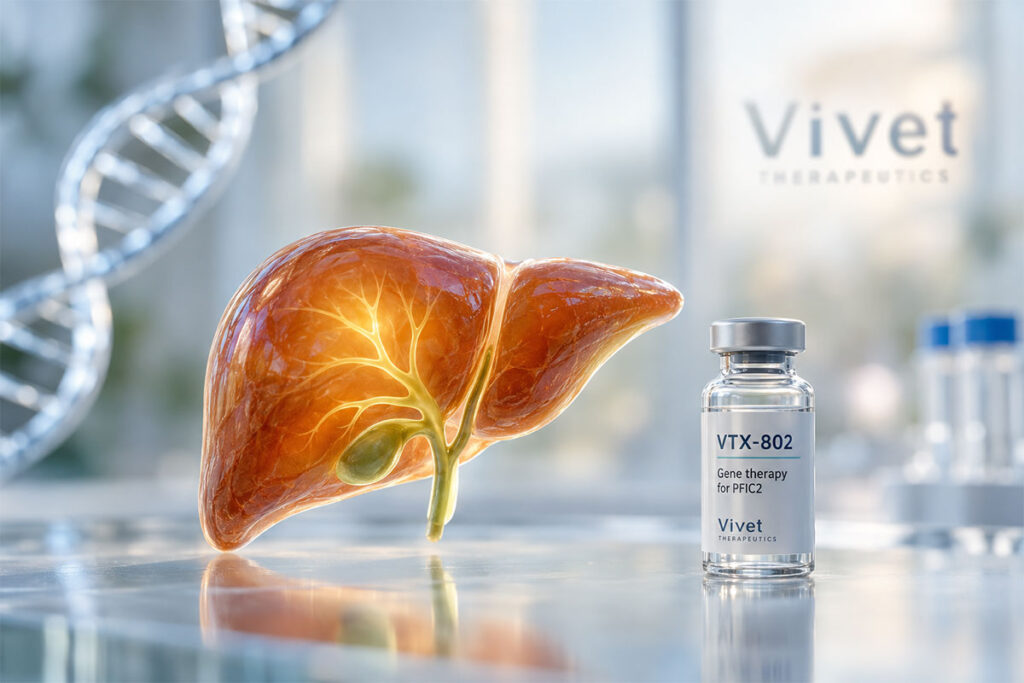
VTX-802 is an AAV vector carrying a corrected, codon-optimized copy of human ABCB11, delivered as a single intravenous injection. Because BSEP normally works only in the liver, and AAV vectors are efficient at reaching liver cells, PFIC2 is well suited to this kind of one-time gene supplementation strategy. In the published study, the vector, carrying the corrected gene under a liver-specific promoter, was tested against an alternative, bile-acid-responsive promoter design; the constitutive version performed better in vivo and was selected as VTX-802.
THE STUDY
What the mouse data showed
Researchers gave VTX-802 to young female mice that completely lack BSEP and reproduce many features of PFIC2, poor bile acid secretion, liver enzyme elevation, and hepatomegaly. A single injection was tested at three doses, with effects followed for up to 15 weeks.
| MEASURE | UNTREATED PFIC2 MICE | HIGHEST VTX-802 DOSE |
|---|---|---|
| Bile acids in bile | ~14% of normal | 55% of normal |
| Bile acids in small intestine | ~8% of normal | ~59% of normal |
| Liver enzymes (ALT/AST) | Elevated | Near-normal |
| Liver enlargement | Marked | Partially corrected |
| Transgene expression | – | Sustained to 15 weeks |
Effects were dose-dependent, well tolerated at every dose tested, and durable across the study period. Restoring the transporter also normalized the balance of bile acid types in bile — including taurocholic acid, which is nearly absent without a working BSEP — pointing to genuinely functional, not just partial, repair of the pathway.
This is a preclinical study in a mouse model. VTX-802 is investigational and has not been studied in humans.
LOOKING AHEAD
What this means going forward
The authors note this is, to their knowledge, the first gene therapy approach reported for PFIC2. Because BSEP loss ranges from partial to complete, a gene therapy that restores transporter function could eventually help patients who don’t respond to IBAT inhibitors today, and might even be combined with them. Open questions the team is already thinking about include how evenly the therapy reaches all areas of the liver, and how durable a single dose will be as young patients’ livers grow.
Citation: Molina A, Trigueros-Motos L, Molina M, Martínez-García J, Palomo L, Pérez G, et al. Liver-directed gene therapy results in amelioration of progressive familial intrahepatic cholestasis type 2 in mice. Hepatology Communications. 2026;10:e1027. doi.org/10.1097/HC9.0000000000001027
Open access under CC BY-NC-ND 4.0. Study funded by Vivet Therapeutics. Several authors are employees, shareholders, or consultants of Vivet Therapeutics; full disclosures are listed in the original publication.